What are the most dangerous animals in Malta and Gozo, and where do you need to be especially careful if you plan to visit these idyllic Mediterranean islands? To ensure your Malta vacation is and remains a dream come true, in this post—which isn’t always entirely serious—I’ll show you the most dangerous animals and the most aggressive predators on Malta and Gozo.
You should be wary of some animal species, while others will barely make themselves known. What walks, flies, and swims in Malta, what is native, and what doesn't actually belong here at all? So that you can assess every animal accurately, I have developed a danger scale that makes it easy for you to distinguish between what can be petted and what will practically eat you alive.
Have a lot of fun and get to know the diverse animal life of Malta and Gozo, and of course Comino (which, by the way, belongs to Gozo). Spoiler: At the end of the post, I'll show you two exciting and worthwhile spots where you can observe many native animals, as well as numerous unsorted photos.
01. Malta Chameleon - Masters of Disguise
Risk assessment 8/10


The Maltese chameleon might just be the cutest animal on Earth, or at least among the very cutest. This is why you need to pay extra close attention here, because these harmless animals in Malta can drive many a tourist to despair. Even though there are an estimated several thousand animals on the islands, they are very difficult to spot.
As masters of camouflage, they like to stay in bushes, but you can find them in both the lush green and the driest, most barren areas of the islands. They even sometimes remain on rusty fences or gray stone walls. The Mediterranean chameleon can change its color from pale yellow to green to almost black.
The reason I give the Maltese wall lizard an 8 out of 10 for danger assessment is, on the one hand, due to the extreme and unavoidable stress you have to endure if you absolutely want to catch a glimpse of such a cute little animal during your already too short vacation in Malta or Gozo.
On the other hand, there are many chameleons along the country roads. For some reason, they gather in the slightly worn bushes and hedges along the roadsides. If you, as a driver, attentive take your eyes off the road, you might spot a chameleon. However, they are rarely run over, as they don't like to move around much. If they like a bush, they stay there and enjoy the view of the traffic.
By the way, it is strictly forbidden to take the Maltese chameleon with you. Nevertheless, it happens regularly. The animals CANNOT be kept in terrariums and die within a few weeks due to travel stress.
Why are there chameleons in Malta? My friend Google once told me that they were allegedly introduced to Malta around 1850 by missionaries from North Africa. Since many parts of Malta are undeveloped and therefore protected, the Maltese chameleon was able to feel comfortable and spread out at ease.
By the way, I saw my first Maltese chameleon at Popeye Village in Malta. In the middle of the hustle and bustle, it changed sides of the sidewalk. When they move, there's a good chance you'll see them because they adopt the color of their surroundings with a slight delay.
02. Lizards and Geckos in Malta
Risk assessment 01/10


There are several species of lizards in Malta. The most dominant species is the Maltese wall lizard, which is endemic and therefore naturally found only in Malta. There are four to five subspecies of this lizard, which differ in color. The most common lizards you will find are green and brown. Except in December and January, you can find them practically everywhere.
But beware, although lizards are not among the dangerous animals in Malta, you have to be incredibly fast if you want to get a good photo. They are very shy and you should not approach them hectically. If you startle them too much, they will unnecessarily shed their tails. Please avoid this for the sake of the animals.
Enjoy the sight and shy company of the differently colored lizards as you explore and observe the reptiles of Malta. It's always worth keeping your eyes open on these islands, allowing you to discover many animals in Malta.


Speaking of discoveries. Besides lizards, Malta is home to two species of geckos. If you're looking to discover venomous animals in Malta, then geckos aren't what you're after. In addition to the robust wall gecko, which is gray-brown in color and prefers to stay on house walls and masonry, you'll also find the European leaf-toed gecko in Malta. A very delicate, small gecko. Its skin is almost transparent with reddish or dark spots. It has characteristic claws on its toes, while the wall gecko has adhesive lamellae on its toes.
03. Snakes and Rolled Ham
Risk assessment 01/10


Finding the most venomous snakes in Malta is a very difficult undertaking. This is because there are no venomous snakes in Malta, or at least they are not venomous to humans. There are four different species of snakes on the islands, all of which are vipers.
Western Whip Snake
One of the animals in Malta that I have seen the least so far is the grass snake. For this reason, I traveled to Comino and saw it there between two bushes. Unfortunately, snakes in general are very difficult to find in Malta, even though the grass snake is diurnal.
European Cat Snake
The only snake on Malta with venom fangs, these are located so far back in the jaw that they are completely harmless to humans. It is crepuscular and I have unfortunately not yet spotted any specimens here.
Leopard snake
Considered the most beautiful snake in Europe with its striking red spots on a light background. It is rather rare and shy. This may also be the reason why I haven't seen this snake in Malta or Gozo yet.
Algerian whip snake
According to Google, it was likely introduced from North Africa a long time ago. It resembles the leopard snake but has paler markings. I have not yet seen this snake live in Malta either.
I find snakes to be very fascinating animals. That's why it's a shame that the snakes here in Malta tend to live hidden away, although naturally, it's no different in other countries. For this reason, so far I only have a single photo of a grass snake. Everything else is photos of snake skins that I found while hiking.
Waltz Skink – The Little Snake That's a Lizard
The skink (Maltese Xink, pronounced Shink) is indeed a lizard, even though it looks more like a snake. Unlike the four snake species in Malta, you see the skink very regularly. It loves large stone walls and has even visited me while I was taking a break in the park. Therefore, I know that skinks like cashew nuts.
The East Australian slaty skink has four fully developed legs with toes, yet moves like a snake. Although it is a very shy island animal, it often stays in the walls of hotels and restaurants, as there may occasionally be something to eat left lying around.
Besides cashew nuts, skinks like fries and salads (personal observations), but in the wild they prefer insects, as well as snails and even the occasional fruit. The skink therefore has a rather balanced diet compared to other animals in Malta.
04. Wild cats, but not wildcats
Hazard assessment 10/10


If there are dangerous animals in Malta, then we should now talk about the native predators. You should beware of these, as they always appear in packs of 7-10 cuddly animals. There are an estimated 100,000 of these beasts for approximately 500,000 inhabitants. We are talking about street cats, which exist in Malta and Gozo. As you can see in my pictures above, they besiege cars, storm apartments, and appear in gigantically large herds.
What is noticeable, however, is that all the cats here appear to be well-fed. This is because the people here take care of the cats. They feed them and even take them to the vet. Additionally, the mild climate ensures that they can survive the winters and reproduce at any time. It is believed that cats were once brought to Malta to deal with the rat problem.
When you walk through the streets of Malta and Gozo, you'll repeatedly find small huts with food bowls and blankets. There are sometimes entire small communities for cats there. If you want to do something nice for the cats, you can buy some cat sticks at the supermarket and give them to eat. Our kids love this, but they always have to walk a long way down the street for it. Otherwise, the kittens are constantly hanging around in front of our house.
But a predator remains a predator, and at least in terms of hunting instinct, wild street cats make it to level 10 on the danger scale.
05. Beetles, Flies, Wasps, and Mosquitoes
Risk assessment 09/10


There are animals in Malta that will simply leave you alone. These include countless species of butterflies, beetles, and cicadas, for example. But then there are also mosquitoes, and they are by far among the most annoying animals in Malta and Gozo. We moved from Barbados to Gozo back then and had gotten used to the small Caribbean mosquitoes. However, in Malta there are the giant European EU mosquitoes. They are real buzzers and you could almost shoot them with buckshot.
However, they only bother you at night or at dusk. One advantage is that Malta mosquitoes make a loud, very typical mosquito sound. That annoying buzzing that everyone knows. When you hear the buzzing, you know what's up. You'll be on the hunt for the next few hours. Since most houses in Malta are built of limestone and are not plastered, it is difficult to see the mosquitoes against the background.
We tried a remedy against mosquitoes in Barbados. We discovered a remedy for mosquitoes. This remedy is extremely effective and very easy to use. It is the following tennis racket, with which you could also compete at Wimbledon.
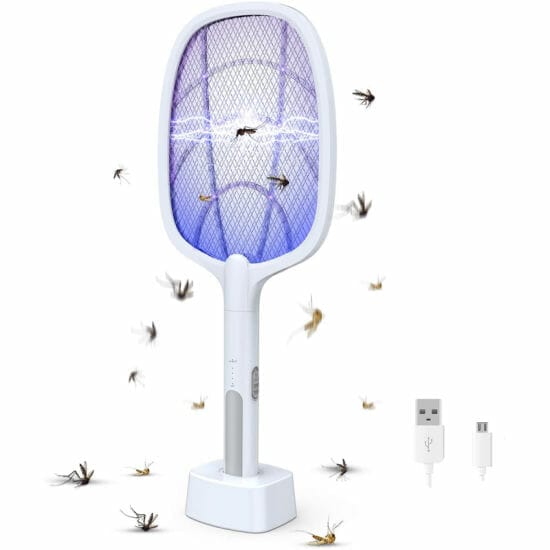
These, also known among Anglo-Saxons as Electric Rackets, are super effective. The best invention ever. It's fast and clean. I find the latter important, as with so many mosquitoes, the walls would quickly look quite bad. I simply leave the racket on in the evening, as it also catches the annoying sandflies, which also bite. However, you have to occasionally shovel away the pile of mosquito corpses.
Wasps in Malta
As I already mentioned in my post about The 10 most dangerous animals in Barbados I prefer mosquitoes to wasps. While Malta does have wasps, they tend to be in tourist areas where people are slurping ice cream all day. They don't really visit us at home on our terrace. I really appreciate that, because it means we can enjoy eating outside comfortably. The most impressive wasp is the Mammoth Wasp (Megascolia maculata, Maltese: Zunzan Bagal).
Optimistically, it is definitely one of the most dangerous animals in Malta and Gozo, and they get really mammoth-sized. Approximately 4.5 cm in size and loud like a small helicopter. However, even it cannot harm a fly, because it is a vegetarian. Unlike the wasps we know, mammoth wasps are solitary. They are exclusively interested in flower nectar and want nothing to do with your food. So they will completely ignore your cake or your BBQ.
Only the females can sting, just like in real life. 😄 But they don't sting, they use their sting for laying eggs. However, if you step on such a female barefoot, you will still feel the sting quite intensely. Since there are hardly any venomous animals in Malta, such a sting won't kill you. The venom is very weak compared to that of a hornet or a honeybee.
Regarding Malta's venomous animals: The next chapter lists some of the most dangerous animals that are highly venomous. However, these are only found in other countries.
06. Malta Spiders, Gozo Scorpions, and Comino Centipedes
Risk assessment 12/10


This is my favorite section. I have repeatedly mentioned in many previous travel reports and posts how much I enjoy observing spiders. While I get even more of my money's worth in countries like Australia and Japan, there are also many great spider species in Malta and Gozo. Spiders in Malta and also spiders in Gozo are very common. However, they are predominantly found outdoors in the bushes and undergrowth. My danger assessment of 12 out of 10 points is so high because, on the one hand, it is far too difficult to observe spiders, scorpions, and especially centipedes. However, if you are looking for dangerous animals in Malta, the last category at the very bottom of the section definitely belongs there.
Spiders in Malta
The only venomous spider in Malta is the brown recluse spider. Its bite can cause skin irritation and allergic reactions. However, this spider is not aggressive at all. You still shouldn't touch or crush it. It doesn't like that very much.

My favorite spider is the Garden spider. In technical jargon, also Argiope lobata or also affectionately black-lobed garden orb-weaver spider called. It is the largest spider in Malta and is very common. If you want to see venomous animals in Malta, you should ignore this spider species. It is as harmless as a small squirrel. However, its webs, which are spun extraordinarily large, are impressive. The spider chills in them all day, hanging upside down and waiting for grasshoppers.
There are approximately 150 spider species in total on the Maltese islands, but you are unlikely to encounter them on beaches or in houses.
Scorpions in Gozo and on all other Maltese islands
As beautiful as the scorpions here are, they are also very rare. In four years, I’ve spotted a total of two scorpions in Gozo. That means I see half a scorpion per year. Still, I find these creatures fascinating. When you see scorpions walking, you can only imagine how heavy and cumbersome it is for them to carry their pincers from A to B. How could nature do this to them?
There is only one species of scorpion in Malta and on the other islands: the Sicilian giant scorpion, uhm... I mean, of course, the Sicilian dwarf scorpion. The scorpions in Malta only grow to about 3-5 cm long. They are nocturnal or avoid direct sunlight and dryness. Therefore, they are more commonly found in stonework and undergrowth. As long as you don't step on them, they won't sting. They are absolutely peaceful creatures. Should you be stung nonetheless, their sting is similar to that of a honeybee. This doesn't necessarily make the scorpions in Malta the most dangerous animals here.
Malta Centipedes or also the Centipedes of Comino
It's getting even more exciting, because there are also centipedes about 10-15 cm long in Malta. The so-called Mediterranean scolopendra is the largest centipede in Europe. In total, there are 25 documented species of centipedes in Malta. However, only the Mediterranean scolopendra is dangerous to humans.
Its front two legs have been reshaped into stingers, and each of these stingers is equivalent to about one hornet sting. It hurts, but it is not life-threatening. Our daughter was stung in Barbados, but by a baby centipede and only by one stinger. Nevertheless, her leg was completely swollen.
Centipedes aren't aggressive. They aren't aggressive at all, but they will bite if they're in your shoes and you step on them or sit on them (like our daughter did) or if you try to pick them up. So it's best to leave them alone, and you'll be fine.
There's a cute house centipede that we also regularly have in our apartment. It eats mosquitoes and sandflies, and it's definitely the kind of centipede you want to have around. We always let it stay in the apartment and don't take it outside.
A subclass of centipedes are the Maltese millipedes. These are Malta’s earthworms. They have around 1,000 legs and are particularly important for the soil. They wouldn’t hurt a fly, and you can safely pick them up. Our youngest loves doing that. I can’t say whether the millipede likes it. Probably not, but we used to collect earthworms in Germany, too. Greta hates this trick! 😅
07. Snails in Malta and Gozo
Risk assessment 00/10


This might sound like a boring section now, one that crawls along slowly and tediously, talking about the many different species of snails in Malta and Gozo. But the snails here are actually quite fascinating. For starters, their danger level is 0.000000, because if they bother and annoy you, you simply eat them. Problem solved. We'll get to that in a moment.
How do snails survive the hot Maltese summer?
This is a question I haven't asked myself even once. However, they do it anyway. When the ground gets too hot, which happens around June, they climb ALL Snails on plants that grow as high as possible from the ground. They seal their shells with a protective layer and wait for the first rain in September/October. To survive this, they go into a kind of summer dormancy for several months.
When you walk across the island, you'll see hundreds of snails sitting on many plants. It's noticeable, and many of the little snails are actually just sleeping. So shhh…
In total, there are 70 different species of land snails, and then of course, just as many that live in the sea. There are even two endemic snail species in Malta. This means they are found exclusively here and nowhere else in the world. The Maltese Heath Snail (Maltese Heideschnecke) and the Maltese Door Snail (Maltese Schliessmundschnecke). The latter has a rather long shell that strongly resembles the architectural style here on Gozo and Malta.
Malta's Cuisine and What Snails Have to Do With It
As mentioned above, people in Malta love to eat snails. And I love them too, even though I’m 95% vegetarian. But snails are always a treat. However, only one species is eaten here on the islands: the spotted vineyard snail. It’s used in two traditional dishes.
- Snail stew (Snail Stew), or often also called Snail Stew. That's how I like them best. The snails are cooked for hours in a thick tomato sauce and lots of garlic, mixed with red wine, potatoes, olives, and herbs.
- Fried Rabbit with Garlic. They're simply the snails themselves, boiled in salt water. They're served with a rich garlic-tomato sauce for dipping and crispy Maltese bread, which is usually soft due to the humidity.
Both dishes are delicious and you should definitely try them when visiting Malta and Gozo. Speaking of delicious: Birds are definitely not eaten here in Malta.
08. Falcons, pigeons, and other low-flying birds
Risk Assessment 07/10 – Animals in Malta


There is an extremely wide variety of poultry in Malta. However, a distinction is made here between native birds and migratory birds. In fact, there are 426 registered bird species in Malta and Gozo, but only about 18 are native and here year-round. Since they are difficult to observe and you have to crane your neck, I estimate the danger at 7 out of 10 points.
Malta is the geographical hub and lies right in the middle of the world's most important bird migration route, called the Central European Flyway. Malta is either the first resting point or the last one just before migratory birds arrive in Africa. Here, they refuel and feed again. Most birds spend only a few hours or days on the islands before continuing their journey. This whole spectacle happens, so to speak, twice a year.
The best birdwatching hotspots in Malta Animals in Malta
Fundamentally, you can, of course, observe birds everywhere in Malta and Gozo again and again. Especially away from the main roads, all kinds of birds flock. But if you actually want to do very serious and scientifically correct birdwatching, then there are three places in Malta that are best suited for it.
- Comino Island – Birdwatching in the Bird Sanctuary
The entire island is a bird sanctuary. Here you can, especially outside the Blue Lagoon, where tourists enjoy the occasional pineapple on the crowded beaches and swimming areas, spotting and observing countless bird species. I recommend the north and east of the island, as significantly fewer people venture here. - Għadira Nature Reserve
This nature reserve is located directly opposite the beach of Mellieħa Bay. There is no entrance fee for the reserve, and you can observe birds from various small huts. It is an area of about seven hectares. Not huge, but lovingly designed and BirdLife Malta managed and maintained. You even get free binoculars here if you go on a tour of the nature reserve. I've also shared my lunch with a skink here before. Experiencing nature in its purest form in Malta, so to speak. - Is-Simar Nature Reserve
I haven't been to this reserve yet, but it is also run by BirdLife Malta managed. Therefore, I'm happy to list it here. It's located in St. Paul's Bay. I can't say more about it, you'll have to try it yourself. - Buskett Woods
There is a very small but beautiful forest in Malta. The Buskett Woodlands are one of the very few contiguous forest areas on Malta. This area is particularly well-suited for observing dangerous animals in Malta. It is especially popular for birdwatching. It was once laid out as a hunting ground, but is now also a bird sanctuary and a Natura 2000 site. These are the nature reserves in Malta.
I love this woodland area because it's also perfect for a picnic with the kids. It's also a green oasis in Malta, especially during the summer months. Here, besides birds, you'll discover many other animals. We saw skinks, frogs, and countless lizards.


If you wish to visit one of the reserves (points 2-4 above), be sure to check out the BirdLife Malta website and inquire about their opening hours. Buskett Woodlands should be open all year round, but better safe than sorry.
About Hunting Grounds. Unfortunately, bird hunting in Malta and Gozo is very popular. At the beginning of each season, you see a vibrant scene of 426 bird species here, which dwindles towards the end. Unfortunately, not because the birds are migrating, but because the hunting season starts exactly when migratory birds arrive in Malta. As popular as hunting is in Malta, it is also illegal. At least for the majority of bird species. For example, it is legal to shoot quails in April. In autumn, there are approximately 40 other species that can be hunted.
However, catching with nets (finch trapping) and shooting birds of prey are strictly forbidden. Nevertheless, it is unfortunately carried out year after year. I support this type of hunting to 0% and have myself once had the experience of how sensitive and cautious hunters are about this illegal issue. On a hike with a buddy through a hunting area in Gozo (outside of the season, of course!) shots were fired at us. Fortunately, the buckshot landed in the ground next to us. The RamboThe hunter, whom we asked for directions earlier, felt it necessary to show us again that the weapons here are real and loaded. 😬
If you read between the lines, the threat assessment increases to 20 out of 10 points if you want to go birdwatching in one of the hunting grounds. You'd better not. The hunters don't mess around there.
Watching ducks, pigeons, chickens, and seagulls, which you'll spot now and then as you move around Malta, Gozo, and Comino, is a bit more relaxing.
09. Praying Mantises and Grasshoppers
Risk assessment 02/10


Malta is one of Europe's Christian countries, so it's no wonder that praying mantises are also found here. Although they resemble locusts in appearance, they are actually more closely related to cockroaches and termites than to locusts. They are purely predatory and carnivorous. Since they are also cannibalistic, with the female occasionally eating the male after mating, I've decided to assign 2 danger points for safety.
Unfortunately, you don't often see praying mantises. They are as well hidden as the scorpions in Malta. On the other hand, you'll see giant locusts or grasshoppers here all the more often. First and foremost is the Egyptian locust, which can grow up to 7 cm long, making it one of the largest locusts in Europe. They are mostly grayish-brown and live on bushes, trees, and our car. Seriously, they seem to like something about it. There are always giant critters sitting on our car.
There are still a whole lot more species of grasshoppers and crickets on Malta, Gozo, and Comino. The biodiversity is great, so you can plan a few extra weeks if you want to see all the grasshoppers here in person.
Here is another table about the differences between praying mantises and grasshoppers:
| Feature | Praying mantis | Grasshopper |
| Lifestyle | Hermit, Stalker | Often gregarious, flight animals |
| Main tool | Thorny forelegs | Jumping legs (rear) |
| Defense | Camouflage (Mimicry) and Threat Displays | Long jumps, escape |
| Noises | Silent (hisses only when threatened) | Typical chirping (male) |
10. Sea Monsters and Great White Sharks in Malta
Risk assessment 01-05/10


As you can surely imagine, in addition to all the poultry and millions of reptiles, there are also some inhabitants of the sea. The Mediterranean Sea, where Malta, Gozo, and Comino are located, holds a great variety of the most diverse marine life. If you put on your diving mask, you can experience octopuses, many Caribbean-colored Mediterranean fish, and also sea urchins and their kind up close and live.
Gozo is considered one of the most popular diving destinations in the world, right after Australia's Great Barrier Reef and the Belize Barrier Reef. Underwater visibility here is often said to be up to 40 meters.
Exciting fact: Due to the warming of the Mediterranean Sea and the deepening of the Suez Canal, more and more tropical species are migrating from the Red Sea. Malta is very centrally located in this migration path. Therefore, you can now find parrotfish and groupers here. There are several shipwrecks that have sunk off the coast. Countless species of these colorful fish teem there.

When snorkeling, you can also observe octopuses and cuttlefish. The latter are masters of camouflage and can change their color in a matter of seconds. They have three hearts and blue blood. I recently discovered a cuttlefish while hiking on the coast. This is the evidence photo on the left. If you're lucky, you can observe them from the shore.
However, this is the first cuttlefish I've seen in four years. I've been told that while snorkeling, some of their kind swim around you. They are absolutely friendly and not aggressive.
One of the most exciting animals in Malta that I've seen so far are dolphins. Especially in the west of Malta, where there are several large tuna farms, several pods of dolphins congregate. We were lucky enough to see a pod of about 20 animals. It is extremely important not to disturb the animals in their territory. We therefore chose a tour that was more scientifically oriented.
Eco Marina Malta offers such tours. They cost around 100 EUR for adults (as of 2026). But you are then on the sea for 8 hours and get lunch, can go snorkeling, and you are taught a lot about dolphins. Patrizia (marine biologist) and her husband lead these tours. We had an exciting and interesting day on their catamaran.


I can highly recommend this tour. Not only will you have a great day, but you'll also be supporting dolphin research. For example, since my day at sea with Eco Marina Malta, I know that a dolphin's dorsal fin is like its fingerprint. Of course, it also ensures that the dolphin doesn't tip over in the water :-). You never stop learning.
There are also many sharks in Malta, but the Maltese shark is only trout-sized and not aggressive at all. More on that in the section after next, when I present two great excursion possibilities for the whole family in Malta.
11. Even More Animals in Malta


Now we're done with the dangerous animals in Malta and Gozo. But of course, there are many more animals here on the islands. If you walk or hike attentively through the beautiful landscape here, you'll see wild rabbits, donkeys, goats, and sheep, some of which are not here entirely voluntarily, in addition to all the animals mentioned above.
You'll also see alpacas here and there. In that case, I can highly recommend the alpaca tours in Gozo. It's fun, especially for families, of course. You can also find many horses, cows, and hedgehogs in Malta and Gozo. Thankfully, I've never seen any hedgehogs, as they apparently cross the road regularly, according to the 100,000 ’Beware of Hedgehogs on the Road" signs.
Last but not least, countless rats scurry in the bushes and the not-so-existent forests. A serious piece of advice: If you're having a picnic, always take your food waste with you. Especially near the coast. If you leave a banana peel there, it attracts rats. The consequence is that this brings rats to the coast, where some of the native bird species also breed. Rats love to raid these bird nests.
That's it for now on the topic of dangerous animals in Malta and animals in Malta in general. As promised, I'll now show you two great excursions that are exclusively about animals.
12. Malta National Aquarium


The Malta National Aquarium is located in the idyllic St. Paul’s Bay, in the northeastern part of Malta. Its iconic architecture catches your eye the moment you get a clear view of St. Paul’s Bay. The building, which looks like a giant white starfish from above, houses the aquarium. Like many places in Malta, the purpose of this „attraction“ isn’t purely entertainment; here, too, the focus is on edutainment.
The Malta National Aquarium teaches exciting facts about Mediterranean marine life and much more. You can also see real aliens here, but more on that shortly. The centerpiece of the aquarium is a 12-meter-long underwater tunnel, which holds around 380,000 liters of water and runs right through the main tank. Since the Malta National Aquarium is located directly by the sea, one would assume that the tanks contain fresh seawater.
However, the water in the aquarium is filtered and treated separately. Great care is taken to ensure that there are no germs or plastic particles in the water. The fish love that. 🐙
You can get cheap tickets for the Malta Aquarium here.
Sharks in Malta and what does the aquarium have to do with it?
If you want to see dangerous animals in Malta, the aquarium is a great place to go. After all, when you think of dangerous animals on an island, the first thing that comes to mind is, of course, the giant white sharks swimming right off the beach. But that’s not actually the case. ☺️
The Malta National Aquarium specifically uses its sharks to break this image and show locals and tourists how important these predators are for the biological balance of the Mediterranean Sea.
There are often information booths at the aquarium, and so we had the good fortune to meet people from Sharklab Malta. They told us how the aquarium gets its sharks. Members of this organization regularly visit the fish market in Valletta, Malta's capital. If sharks (mostly caught as bycatch) are caught there, they examine whether the females are carrying fertilized eggs.
These eggs are rescued and brought to the aquarium. They are monitored in laboratories and quarantine tanks for months until the small catsharks hatch. Once the animals are strong enough, they are released by divers, meaning they are returned to the sea. The aquarium has successfully released well over 300 sharks back into Maltese waters so far.
Aliens in Malta
Back to the aliens in Malta. They actually exist. As mentioned much earlier, fish from the Red Sea enter the Mediterranean through the Suez Canal. They are called aliens because these fish are accustomed to a completely different habitat. One of these aliens, for example, is the Lionfish, as the Germans say. This fish, which I often saw while snorkeling in Barbados, is extremely dangerous and actually poisonous. Divers should always report a sighting directly to the aquarium so that populations can be controlled.
A pufferfish has also found its way to us. It is highly poisonous, but only if you eat it. Furthermore, there is now the trumpetfish in the Mediterranean. It is an extremely long and thin fish. I only know it from Barbados. In the aquarium, you can see it in a tank of more exotic species.
I've been supporting the Malta National Aquarium for a few years with an annual membership because I find it great that they take a scientific approach to their work. It's not about attracting the maximum number of tourists, but rather about prioritizing the animals. That's why, for me, the Malta Aquarium isn't just a classic bad-weather option in Malta, although we tend to visit regularly in the winter.
BirdPark Malta – St. Paul's Bay


Update June 2026: Due to the explosion of a fireworks factory in the immediate vicinity, the park is currently closed. Unfortunately, large parts were destroyed and many animals did not survive. If you want to help, here's how you can do it. Inform yourself beforehand Facebook, if the park has opened.
The BirdPark Malta is also located in the picturesque St. Paul's Bay, although it's a bit hidden inland. It's not heavily advertised and is therefore considered a local tip in Malta. I've only been there once and find the park really great and exciting.
Similar to the Malta National Aquarium, BirdPark Malta is considered a sanctuary for injured and migratory birds. It is an oasis of green, completely breaking the typical dry and rocky image of Malta. Besides flamingos, pelicans, storks, and owls, you can even encounter kangaroos here. The park has some wallabies from Australia.
The park is home to around 200 bird species, mostly animals that have been rescued, rehabilitated, and found a new home in the park.
Of course, there are no dangerous animals here. However, you shouldn't get too close to the owls and falcons, because their talons and beaks do tend to snap at a finger or two.
Conclusion – Dangerous Animals in Malta and Gozo
Now you hopefully have a good overview of the animal diversity in Malta and Gozo. Of course, I titled it „Dangerous Animals in Malta“ with great irony. You may have already noticed that my contribution is also meant to be funny here and there. But in reality, there is a great diversity of different little animals here in Malta and Gozo. The idea that Malta has venomous animals is, of course, far-fetched.
Of course, it happens here and there in the sea, but divers know that better than I do. With this article, I want to give you a good overview and encourage you to also consider Malta and the neighboring islands of Gozo and Comino when it comes to animal observation and the like. It's worth it. Promise!
I can also reassure you with peace of mind that your next vacation in Malta is safe. You won't be eaten here, and you don't have to be afraid of poisonous spiders and scorpions in Malta, unlike in Australia, Thailand, and Japan, where it is sometimes the case.
Now I wish you a lot of fun planning your next trip, and afterwards, I've put together some great photos for you in an unsorted gallery below.


- About the Author
- Latest posts

On my travel blog Wandernotizen I'll take you along on our family trips around the globe. Between wanderlust and everyday chaos, you'll find honest travel reports, tips, and plenty of material to ignite your wanderlust. 🧭 ❤️ 🏝️